Puffin Crossing: What It Is, How It Works, and Why It’s Different From a Pelican
Most people walk over a puffin crossing every week without ever knowing its name, let alone what makes it different from the crossing on the next street over. That’s the strange thing about UK road design — it’s full of quietly clever engineering that nobody stops to notice. A puffin crossing is one of those pieces of engineering. It looks, at first glance, like any other button-operated pedestrian crossing. But underneath the surface, it’s running on sensors that are constantly reading how fast you’re walking, whether you’ve actually stepped onto the road, and whether you’ve changed your mind and wandered off.
This guide breaks down exactly what a puffin crossing is, how the sensor system actually works, how it differs from a pelican or toucan crossing, and what learner drivers in particular need to know before their test. If you’ve ever wondered why some crossings have a flashing amber light and others don’t, this is where that question gets answered properly.
What Is a Puffin Crossing, Exactly
Puffin stands for Pedestrian User-Friendly Intelligent crossing — a name that’s a bit of a mouthful, but it does explain the point of the design. It’s a signal-controlled crossing found across the UK that replaced a lot of the older pelican crossings starting in the late 1990s. Pedestrians press a button on a black-and-yellow box to request a crossing phase, then wait for a red or green figure to appear.
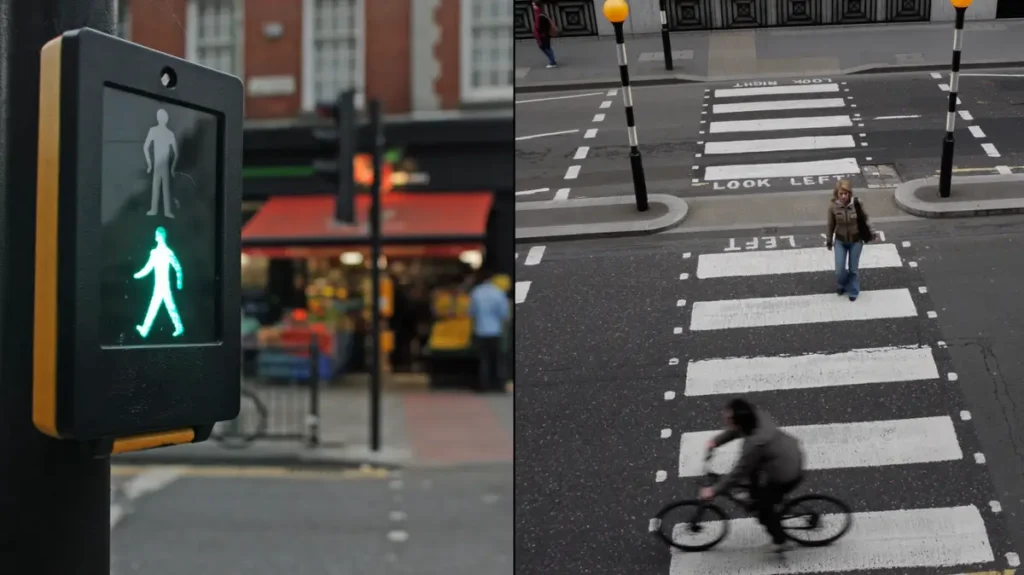
Where it gets interesting is the placement of that figure. On a pelican crossing, the pedestrian light is mounted on a pole on the far side of the road, so you’re looking across traffic to see when it’s safe. On a puffin crossing, the red and green man sit on the same box as the push-button, right at your side of the pavement. That’s not a cosmetic choice. It means you can watch the signal and the oncoming traffic in the same field of view, and it means people with visual impairments don’t have to strain to see a light thirty feet away across a busy road. Many of these units also have a tactile spinner underneath that rotates when it’s safe to cross, which matters a lot for anyone who can’t rely on the light itself.
The Sensor Technology That Actually Runs the Show
This is the part most explainers skim past, and it’s the part that genuinely separates a puffin from everything else on a British road. Puffin crossings run on two separate detection systems working together. The first is a pedestrian crossing detector, sometimes shortened to PCD, mounted above the crossing looking down at the road surface. Its job is to track whether someone is still out there walking and how quickly they’re moving. If an elderly pedestrian or a wheelchair user needs longer than the standard crossing time, the PCD holds the red light for traffic until the road is actually clear — not until a fixed timer runs out.
The second sensor is the pedestrian kerb detector, or PKD, which watches the area right by the button box. Its job is almost the opposite: cancelling a request. If you press the button and then decide to cross before the lights change — plenty of people do, especially when there’s an obvious gap in traffic — the PKD notices you’ve left the kerb and calls off the request so traffic doesn’t get held up for someone who’s already crossed. It also cancels the request if you press the button, then simply walk away and give up on crossing there at all. That’s a small thing, but it’s a big part of why puffin crossings tend to keep traffic moving better than older designs. The system reacts to what pedestrians are actually doing, not to a pre-set clock. techware
Puffin vs Pelican vs Toucan: The Differences That Actually Matter
The alphabet soup of UK crossings trips people up constantly, so it’s worth being precise about where puffin crossings sit in that lineup. A pelican crossing uses a flashing amber phase after the red light — drivers can proceed if the crossing is clear, but they have to give way to anyone still on it. Pelican crossings also run on fixed timing rather than live sensor data, and the pedestrian signal faces across the road rather than at the kerbside.
A puffin crossing drops the flashing amber phase entirely. The sequence for drivers runs red, then red-and-amber, then green, exactly like an ordinary set of traffic lights — no ambiguity, no judgment call about whether it’s safe to edge forward. For pedestrians, there’s no flashing green man either; you get a steady red or a steady green, full stop, with a beep to confirm the green phase (local councils sometimes limit that beep near residential streets at night). A toucan crossing is closely related but built to let cyclists cross alongside pedestrians without dismounting, which is why “toucan” is a pun on “two can cross.” A Pegasus crossing follows the same sensor logic as a puffin but with the button mounted higher, at a height a rider can reach from horseback. If you can remember one rule, it’s this: no flashing amber, near-side pedestrian lights, and sensor-driven timing means you’re looking at a puffin.
Why the Design Exists in the First Place
The rationale behind puffin crossings goes back to a fairly simple safety problem with older crossings: fixed timers don’t account for real people. A crossing timed for an average adult’s walking pace is genuinely dangerous for someone using a mobility aid, an older pedestrian, or a parent managing a pushchair and two kids at once. Fixed-time systems either force people to hurry dangerously or waste huge amounts of green-light time on empty roads because the timer has to be set for the slowest realistic case every single time.
Sensor-based crossings solve both problems at once. Traffic only gets held for as long as someone is actually on the road, which is safer for the pedestrian and less disruptive for drivers waiting behind. The near-side signal placement solves a separate problem — for a visually impaired pedestrian, looking directly across a live road to find a small light is genuinely hard, and doing that while also watching for turning vehicles is worse. Having the signal right where you’re already standing removes that conflict entirely. It’s a rare case of a piece of civic engineering doing more with less: fewer assumptions baked into the timing, more responsiveness to who’s actually there.
Myths and Mix-Ups Worth Clearing Up
The most common mix-up, especially among learner drivers, is expecting a flashing amber phase at a puffin crossing the way you would at a pelican. It isn’t there. If you’re waiting for that cue before moving off, you’ll simply be waiting at a green light while traffic behind you starts to get impatient. The examiner-tested rule is straightforward: at a puffin, you treat the light exactly like a normal traffic signal, because that’s precisely how it’s built to behave.
Another persistent misunderstanding is that puffin crossings use cameras to track pedestrians in some more invasive, image-based way. They don’t — the detection is done by infrared and microwave-based motion and presence sensors mounted above the crossing and near the kerb, not video surveillance systems watching who’s crossing. It’s also worth clearing up the idea that puffin crossings are somehow slower for traffic than older designs. The evidence points the other way: because the red phase only lasts as long as someone is genuinely on the road, drivers on average lose less time at a puffin than at a fixed-timer pelican, especially outside peak pedestrian hours.
What’s Changed Recently
Puffin crossings themselves are a mature, well-established piece of UK infrastructure at this point, not a new rollout — most of the country’s older pelican crossings have already been converted or replaced with puffin or toucan versions over the past two decades. Where there’s genuinely live movement is on the driving test side. Current DVSA guidance for 2026 continues to treat correct crossing recognition as a serious-fault risk area, and instructors are seeing this tested more deliberately during the observation and hazard-perception portions of the practical exam, since so many learners still default to pelican-style expectations out of habit. If you’re studying for a theory or practical test this year, treat “no flashing amber, near-side signal” as one of the facts worth over-learning rather than something to half-remember.
Frequently Asked Questions
What does puffin actually stand for? Pedestrian User-Friendly Intelligent crossing. The name describes the sensor-driven design rather than the bird — it’s a coincidence of acronyms, not a themed name.
Is a puffin crossing the same as a pelican crossing? No. They look similar at a glance, but a pelican uses a fixed timer and a flashing amber phase for drivers, while a puffin uses live pedestrian sensors and skips the flashing amber entirely.
Why is the pedestrian light on the same side as the button on a puffin crossing? So pedestrians can watch the signal and oncoming traffic at the same time, and so people with visual impairments don’t have to look across the road to see when it’s safe to cross.
Does a puffin crossing beep when it’s safe to cross? Yes, typically, though some councils reduce or mute the audible signal during night hours in residential areas to cut down on noise.
What happens if I press the button and then cross before the light changes? The kerbside sensor detects that you’ve left the pavement and cancels your request, so traffic isn’t held up unnecessarily for a crossing that’s no longer needed.
Do puffin crossings use cameras to watch pedestrians? No. They rely on infrared and microwave motion and presence sensors, not video surveillance, to detect whether someone is waiting or still on the crossing.
The Bottom Line
A puffin crossing isn’t flashy engineering, but it’s a genuinely smart response to a problem that fixed-timer crossings never solved well: real pedestrians don’t move at one uniform speed, and traffic shouldn’t be held hostage to a clock that ignores that. Between the near-side signal placement, the dual-sensor system, and the straightforward red-amber-green sequence for drivers, it’s a design that quietly makes both sides of the road safer without asking anyone to think much harder about it. Next time you’re waiting at one, you’ll know exactly why it’s built the way it is — and why that flashing amber light you might be expecting was never going to show up.